
Outdoor Umbrella Stands, Bases & Mounts



Portable patio umbrella stand or permanent mount – what’s the right choice?
Choosing the right umbrella base or mount is critical to how your shade performs day to day. The right support keeps the umbrella stable in normal wind and casual bumps, while the wrong one can make even a premium umbrella feel sketchier than it has any right to.
The main decision is whether you need a freestanding base that can move with the layout or a permanent mount that saves space and delivers greater long-term stability. The best choice depends on umbrella type, canopy size, surface conditions and how exposed the site is to wind.
Freestanding patio umbrella stands
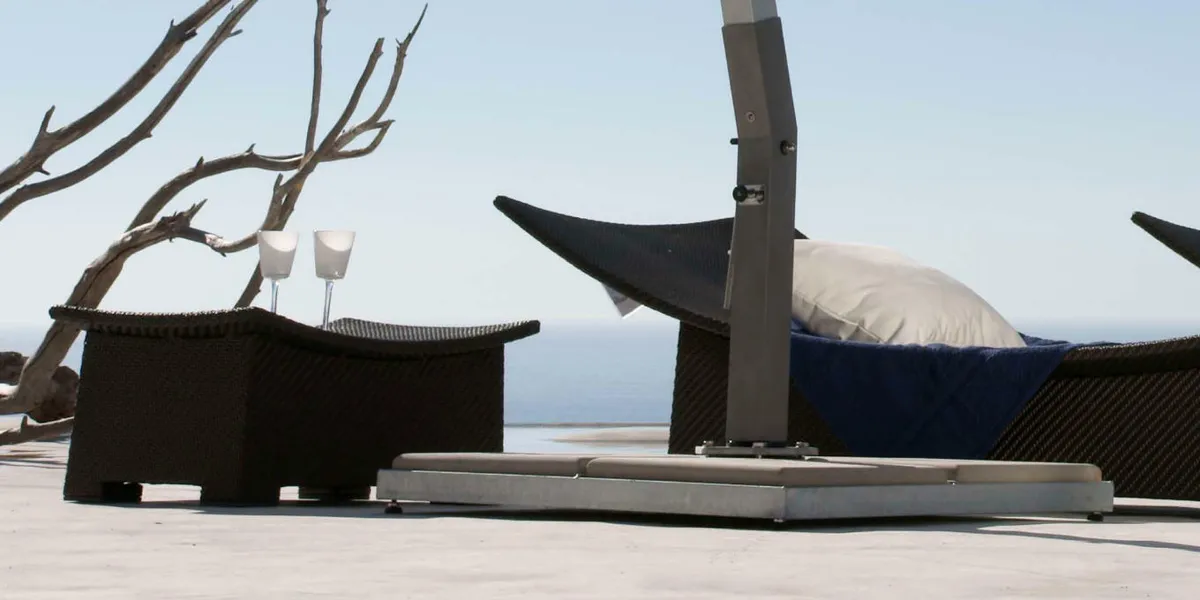
Freestanding bases work with both market and cantilever umbrellas, but they don’t require the same amount of ballast. Center pole umbrellas typically use lighter bases, especially when the pole runs through a dining table, while cantilevers need much heavier support to counterbalance the offset canopy.
Manufacturers often publish compatibility charts for base weight and umbrella size, but a common rule of thumb in normal wind is about 10 pounds per canopy foot for a freestanding market umbrella and around 5 pounds per foot when it runs through a table. Cantilever umbrellas usually need much more support, often in the 30 to 40 pounds per canopy foot range or higher in exposed areas, so manufacturer recommendations should always take priority.
Some large cantilever umbrellas need 400 to 500 pounds or more, and if you plan to move that much weight around, wheels quickly stop feeling optional and start feeling like a very good idea. Base pricing also varies widely by weight, material and finish, from simple concrete models to large aluminum or steel designs with wheels and decorative covers.
For more detail on sizing, mounting and weight guidance, see the bases and mounts section of our comprehensive Patio Umbrella Buying Guide.
Fixed-weight umbrella bases
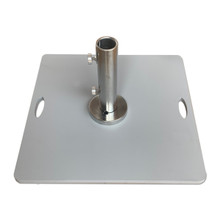
Many umbrella bases come in fixed weights or sizes that can’t be adjusted. Some are solid one-piece designs, while others use decorative housings or covers to conceal the ballast and better coordinate with surrounding furniture and finishes.
Common weight materials include steel, iron, aluminum, granite and concrete. Covers are often made of powder-coated aluminum or durable plastic and can range from purely functional to surprisingly refined, which is nice because few people set out hoping their umbrella base becomes the visual centerpiece.
Adjustable-weight parasol bases
Other base systems allow you to add weight as needed. This can be especially helpful when working with larger canopies, windier locations or setups that may change over time.
- Metal plates – Wide, stackable steel plates that can weigh 100 pounds or more each and often sit at the premium end of the price range.
- Pavers – Stone or concrete pavers stacked in a steel framework, sometimes with a cover; a more economical way to reach higher weights.
- Sand or water – Hollow lower-cost bases filled with sand, water or gravel. These are usually best for lighter-duty residential use rather than large canopies or exposed sites.
Pro tips – key umbrella base and mount details to compare
- Umbrella type – Market and cantilever umbrellas need very different amounts of support, so always match the base or mount to the specific umbrella design, not just the canopy size.
- Weight and wind exposure – Rules of thumb are a useful starting point, but exposed settings often require more ballast than the baseline recommendation.
- Pole compatibility – Check pole diameter and sleeve size carefully, especially if the umbrella will pass through a table. A base can be heavy enough and still be the wrong fit.
- Portability – Wheels, handles and modular weight systems matter more than they seem at first, particularly once the base gets heavy enough to make “we’ll just move it later” sound ambitious.
- Surface type – Concrete, stone, pavers, hardwood decking and soil all create different requirements for permanent mounts.
- Clearance and footprint – Some bases are compact and vertical, while others are low and wide. Make sure the footprint works with table legs, chair movement and circulation around the space.
Permanent patio umbrella mounts
Permanent mounts usually provide greater stability than freestanding bases, take up less floor space and can be more cost-efficient at higher weights. The tradeoff is flexibility: once a mount is installed, the umbrella is generally tied to that location unless you plan for multiple mounting points.
Even with a fixed mount, the umbrella itself can usually be removed and stored during storms or the off-season. That makes permanent mounting a strong option when you want cleaner sightlines and dependable performance without giving a massive base the starring role on the patio.
In-ground mounts
In-ground mounts are a common solution for backyards and the edges of patios or decks. A steel sleeve or support is set into a concrete footing below grade, then paired with an adapter or plate that receives the umbrella.
Planning for excavation, concrete work and curing time matters more here than the cost of the sleeve itself, but the result can be a very clean look with excellent stability.
Surface umbrella mounts
Cantilever and market umbrellas can also be mounted directly to structural surfaces using surface-mount hardware. These systems typically bolt into concrete or, with the correct hardware and support, through a deck.
- Concrete mounting – Steel plates or posts bolted directly into concrete, often with minimum thickness and anchor requirements for safe installation.
- Deck mounting – Mounts for hardwood or similar decking usually connect above and below the deck surface to distribute loads and may come with stricter structural limitations.
If you’re unsure which mount is appropriate for your site, review manufacturer guidance and consider checking with a contractor before installation. It’s much easier to plan around structure and substrate early than to discover later that the umbrella and the surface had very different ideas.
Frequently Asked Questions – Umbrella bases and mounts
How heavy should a patio umbrella base be?
It depends on the umbrella type, canopy size and whether the pole runs through a table. A common rule of thumb is about 10 pounds per canopy foot for a freestanding market umbrella and around 5 pounds per foot when the umbrella is supported through a table.
Cantilever umbrellas usually need much more support, often around 30 to 40 pounds per canopy foot or more in exposed areas. Manufacturer recommendations should always take priority, especially for larger or commercial-grade models.
When does a permanent mount make more sense than a freestanding base?
A permanent mount often makes more sense when you want maximum stability, less floor obstruction and a cleaner overall look. It’s especially useful for larger umbrellas, exposed sites and layouts where the umbrella will stay in the same location long term.
Freestanding bases are the better fit when flexibility matters more and the layout may change over time. The tradeoff is that they usually take up more space and may need much more visible ballast.
Can I use the same base for different umbrellas?
Sometimes, but not automatically. The base needs to match the umbrella’s pole diameter, weight requirements and overall design, and that’s before wind exposure gets a vote.
A base that works for one market umbrella may be completely wrong for another, and cantilever umbrellas usually require brand-specific or model-specific base systems. It’s always safer to confirm compatibility than to assume “close enough” will be close enough.
