
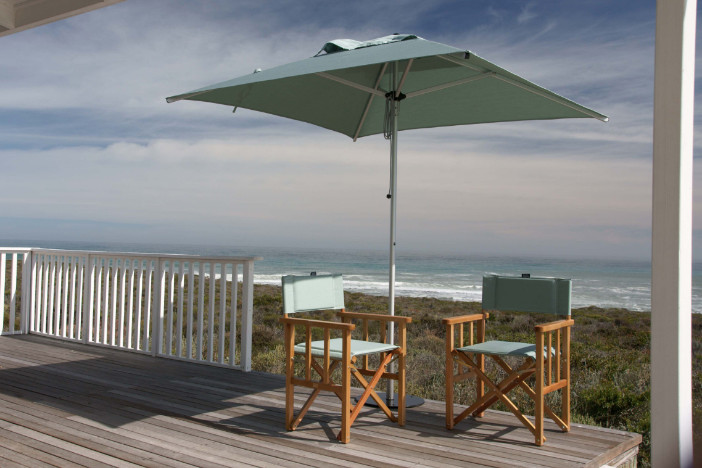
Most home patios and decks are asked to do several jobs. Breakfast happens there, so do weeknight dinners, laptop time, quiet reading, neighbour drinks and whatever version of “we’ll just eat outside” turns into everyone staying for two hours. Shade has to keep up with that rhythm without making the space feel crowded or fussy. The sun doesn’t care which zone the family thinks is “primary.” It just keeps moving, and the shade plan has to be good enough to keep up.
Picture a family patio on a Saturday. There’s a dining table near the house, a small lounge cluster facing the yard, a grill and prep counter along one edge and a chair in the corner that someone quietly claims most afternoons. By noon the table matters most. Later it’s the lounge. By evening people drift again. In that setting, the right umbrella isn’t just the one that shades one spot well; it’s the one that can follow how the patio actually gets used.
That’s the big difference from many commercial settings, especially outdoor restaurants. At home, the homeowner is also the operator. If an umbrella is easy to move and worth moving, someone probably will. If sliding the umbrella over a few feet makes the whole evening better, that’s not a chore; it’s just how the room works.
How home patios and decks behave
A lot of residential outdoor spaces share the same basic pattern: one main surface just outside the house, with several activities happening at once. The furniture may suggest zones, but the space still behaves like one room.
That usually means:
- A table for meals and occasional work.
- A lounge area for reading, talking or resting.
- A grill zone or small outdoor kitchen.
- One or two small nooks that become favorite spots almost by accident.
People move freely between those zones. Plates travel. Chairs migrate. Kids cut across the middle. Shade works best when it accepts that and supports the patio as a flexible room rather than a frozen diagram.
That’s also why richer adjustment can make sense at home. Moving the shade is part of using the space, not a disruption.
Center‑pole umbrellas as simple anchors
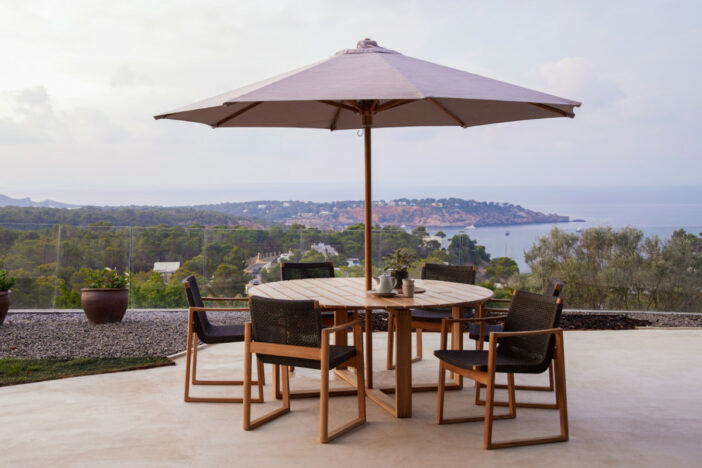
For many homes, a center‑pole umbrella over the main table is still the simplest way to create reliable shade. It gives the patio one clear, dependable place to sit for lunch, coffee or a bit of work without much thought.
This works because it’s easy to understand:
- The table becomes the shaded anchor of the space.
- Opening and closing the umbrella fits into the daily routine.
- Guests know what to expect when they head for that seat.
Tilt can help now and then, especially with low sun, but even at home most of the real work comes from good placement and enough canopy to cover people, not just the tabletop. A center‑pole umbrella is often right for households that want straightforward shade at the dining table and don’t need that umbrella doing three jobs. Sometimes the most advanced feature a patio needs is “open it, sit down, stay there a while.”
Cantilevers where flexibility pays off
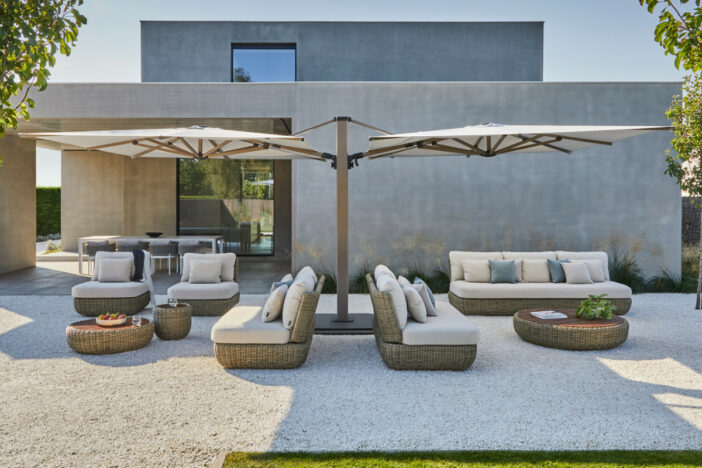
Cantilever umbrellas are where residential patios start to separate from many commercial ones. Their offset mast keeps the space under the canopy open, and that makes it possible for one umbrella to cover more than one zone on the same surface.
A well‑placed cantilever can:
- Shade the dining table during breakfast or lunch.
- Swing toward a seating cluster later in the day.
- Reach part of a grill or prep area enough to make cooking more comfortable while staying clear of heat and smoke.
Here, rotation and tilt stop feeling like brochure filler and start doing real work. If the canopy can be rotated and angled without much effort, one umbrella can follow the life of the patio through the day. The test isn’t how many positions an umbrella has; it’s whether anyone bothers to use more than two of them after the first warm weekend.
Mechanisms people will actually use
At home, the question isn’t how fast staff can reset the patio. It’s whether the umbrella is pleasant enough to operate that someone will bother to move it when the sun shifts.
That points toward:
- Smooth crank lifts that don’t feel stubborn.
- Clear, easy‑to‑reach controls for rotation and tilt.
- Mechanisms that feel intuitive rather than mysterious.
An umbrella can have every feature in the catalog, but if it takes too much effort to use, it will end up in one position most of the season. Good residential hardware earns its keep when the family actually interacts with it.
Bases, movement and limits
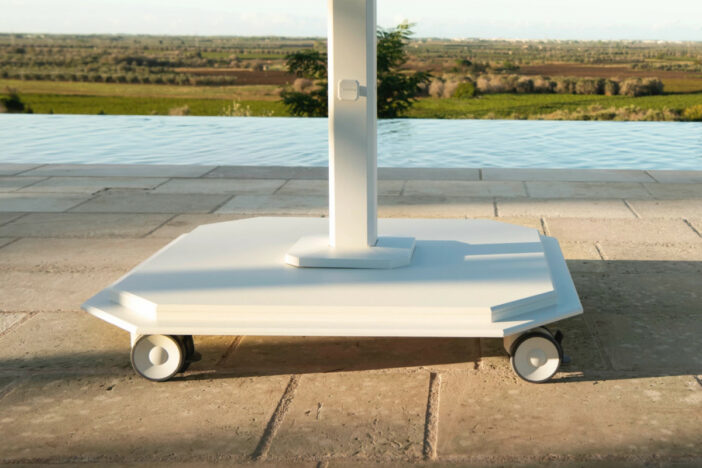
Home settings are where portable and wheeled bases make the most sense. A homeowner can reasonably roll a cantilever between a few planned spots on the same patio or deck, especially when the surface is smooth and the route is short.
Portability still has limits. A heavy base that seems manageable in theory can become irritating fast if it has to weave around furniture, cross uneven paving or deal with steps. Once stairs enter the picture, one umbrella serving multiple levels usually stops being clever and starts being annoying.
A better rule is one level at a time. If the upper deck handles dining and lounging while a lower terrace has its own seating or hot tub area, each level probably wants its own main shade point. The umbrella should flex within that surface, not be expected to travel the entire property.
Fixed and natural shade in the background
Most homes already have some other shade at work, even if imperfect:
- Roof overhangs and eaves near the house.
- Pergolas or light structures over parts of the patio.
- Trees and taller planting that soften sun in certain areas.
Shared commercial terraces deal with a similar mix of planted shade and hardware, but under lighter day‑to‑day oversight.
Those elements set the background conditions. They might make the dining zone comfortable in the morning, or shelter one edge of the patio while leaving another exposed later in the day.
Umbrellas form the adjustable layer on top. They refine comfort in the places people actually sit: a favourite chair just beyond a tree canopy, a dining table that still catches noon sun, or a lounge area outside the overhang can all become more useful with one well‑placed umbrella. It doesn’t have to solve the whole yard. It just has to solve the right problem.
Patterns that work at home
Most residential patios fit a few common layout types.
Single multifunctional patio or deck
Here, one surface holds dining, lounging and often the grill. A common pattern is one primary cantilever placed so it can swing between the main table and lounge, plus an optional center‑pole umbrella that stays focused on the table. That gives the patio one reliable shaded anchor and one flexible shade tool.
Multiple levels or separated outdoor rooms
Once the yard breaks into an upper deck, lower terrace and side seating nook, it usually makes sense to assign each level its own main shade element. One umbrella can still do more than one job on that level, but it shouldn’t be expected to cover the entire property.
Larger property with patio, secondary zone and pool
On larger lots, the near‑house patio, a more distant lounge or kitchen area and the pool each act as distinct outdoor rooms. In that case, treat each on its own terms: the house patio might use the dining‑plus‑cantilever pattern, a secondary lounge may need its own umbrella, and the pool zone gets shade that matches how that household actually uses the water.
Across all three patterns, the principle stays the same. Start with how the family really uses the space, then choose a small number of umbrellas that can support those habits without making the patio feel busy. At home, flexibility is a means to comfort, not the goal in itself.
Home patios and decks are where flexible shade most often earns its keep, because the household can actually use the movement and adjustment when it makes life outside better. Starting from how the family really lives in the space, then choosing a small number of umbrellas or structures that follow those habits, keeps the yard feeling inviting instead of overcomplicated. If the outdoor spaces at home start feeling more “of course we’ll sit out here” and less “why is this always a compromise,” the shade is doing its job. For readers planning shade across a whole property or mixed‑use site, the other pieces in this shade‑planning series show how the same logic adapts when guests, staff and building programs enter the picture.









Leave a Reply