
Fire Pits




Fire pits as the social anchor of your outdoor space
Fire pits are designed as much for gathering as they are for warmth. A well-chosen fire pit gives people a comfortable reason to stay outside longer, along with the light, movement and visual focus that make a patio feel more inviting after dark.
Once you know you want an open-flame focal point, the important questions become which fuel and configuration suit your space, how permanent you want the installation to be and how the feature can sit safely within the rest of your outdoor layout.
Choosing the right fuel for your fire pit
- Natural gas - Best when you have, or plan to add, a plumbed gas line and know the fire pit’s location will remain fixed. It provides a convenient, continuous fuel supply once installed, but requires proper planning, professional installation and attention to required clearances and local code.
- Propane - A flexible option that does not require a permanent gas line. Propane can be a practical choice when a fire pit needs to work in a location without natural-gas service, but tank accommodation varies by model. Some designs conceal the tank within the base, while others require it to sit remotely.
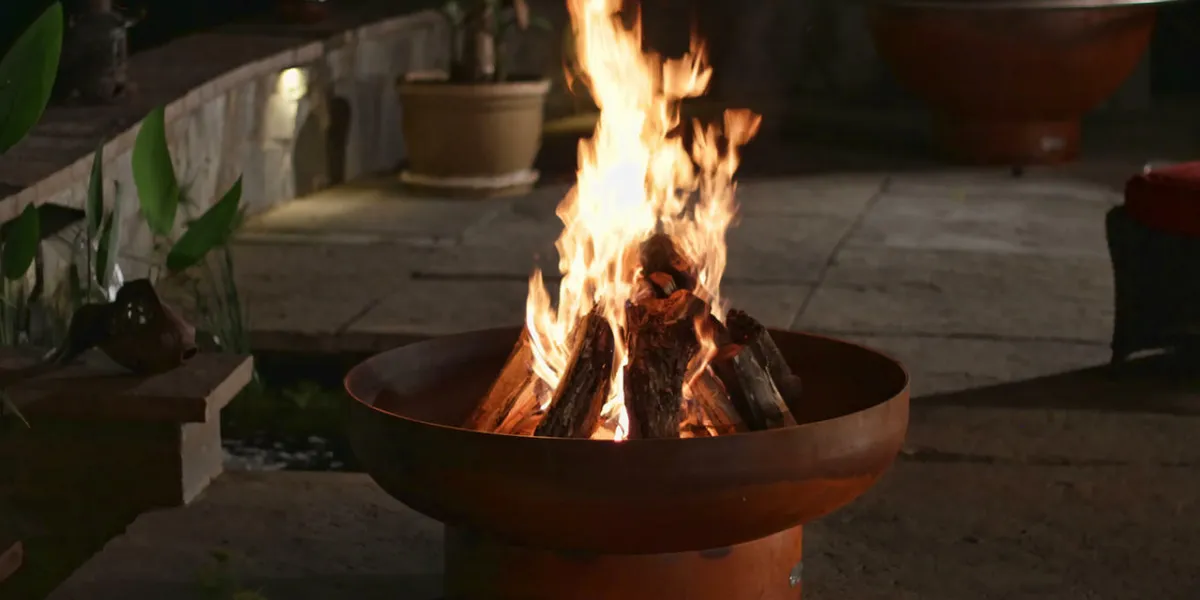
- Wood-burning - The most traditional live-fire experience, complete with crackle, scent and glowing embers. Wood-burning fire pits can involve more smoke, sparks, ash, fuel storage and local restrictions, so they are best for spaces with adequate clearance and owners who enjoy a more hands-on ritual.
If you would like a deeper dive into fuel behavior, pros and cons and emissions, our fire pit fuel types guide breaks down the tradeoffs in more detail.
Built-in vs. self-contained fire pits
Built-in fire pits become part of the architecture. They are typically integrated into masonry, hardscape or a custom outdoor-living plan, often using a fire pan and burner system within a finished surround. They make a strong visual statement in one specific location, but require more coordination, construction planning and a clear answer to the question: “Do we really want the fire here for the long haul?”
Self-contained fire pits arrive as finished fire features, often in GFRC concrete or steel, with the body, burner system and finished form designed to work together. They can feel just as substantial and intentional as a built-in feature, but generally offer a more straightforward path to installation. Depending on the model and fuel type, they may still require a fixed gas line, a concealed or remote propane tank, professional setup and a carefully chosen location.
Material matters as much as configuration. GFRC concrete gives a substantial architectural look without the extreme weight of traditional precast concrete. Powder-coated steel offers a tailored, color-forward finish, while Corten steel develops a naturally weathered patina over time. Choose the material that complements the setting and matches the amount of maintenance and natural variation you are comfortable with.
As a general safety baseline, keep open flame a generous distance from buildings and combustible materials, and allow appropriate clearance from trees and overhead structures. The manufacturer’s instructions, the specific installation and local requirements should always have the final say.
If you are still deciding between a built-in project and a finished fire pit, our outdoor fire pit buying guide walks through layouts, sizing and installation in more depth.
Pro tips: choosing a fire pit that fits your space
- Match the fuel to your patience and surroundings - Wood delivers ritual and drama, but also smoke, embers and more local rules. Gas burns cleanly and offers simpler operation, especially in tighter neighborhoods and established seating areas.
- Scale the fire to the seating, not just the patio - A large fire pit on a compact terrace can feel overbearing, while a small burner in a wide-open yard can disappear. Think about how far people will sit from the flame and how many chairs you actually use at once.
- Choose materials for the setting - GFRC concrete, powder-coated steel and Corten steel each create a different visual effect and age differently outdoors. Consider the surrounding furniture, finish palette, climate and your tolerance for natural patina or maintenance.
- Plan for accessories up front - Lids, covers, fire media, glass wind guards and ignition upgrades can meaningfully change day-to-day use. It is easier to choose a fire pit that supports the accessories you will actually want than to retrofit them later. Explore compatible items in Fire Feature Parts & Accessories.
- Know your local rules before you fall in love - Municipal requirements, HOA rules and site-specific clearances can affect where and how an open flame can be used. A quick check now is better than discovering your preferred fire pit is not suitable for the intended location.
Explore related fire features
Fire Tables
Choose a fire table when you want the atmosphere of an open flame with a more functional surface for drinks, entertaining and relaxed conversation.
Outdoor Fireplaces
For a more permanent architectural focal point, explore our outdoor fireplaces for built-in outdoor rooms and project-oriented installations.
Fire Sculptures
Architectural fire sculptures pair ambient flame with sculptural metal forms for a more design-forward outdoor statement.
Fire Feature Parts & Accessories
Shop fire feature parts and accessories, including fire media, burners, ignition components, wind guards, covers, lids and replacement parts.
Frequently Asked Questions – Fire Pits
Which fire-pit fuel is best for my space?
There is no single winner for every patio. Natural gas is usually the best choice when you want a permanent fire feature in a fixed location and have access to a properly installed gas line. Propane is a practical option when you want a finished gas fire pit without adding permanent fuel piping, although you should confirm where the tank will be stored or placed.
Wood-burning fire pits deliver the most traditional campfire experience, but demand more attention to smoke, sparks, fuel storage, ash and local rules. The best choice depends on your site, installation options and how hands-on you want the experience to be.
How much smoke should I expect from a wood-burning fire pit?
All wood fires produce some smoke, even in well-designed fire pits. You can usually reduce it by burning dry, seasoned hardwood, keeping the fire pit clean and giving the fire enough airflow so the wood burns hotter and more completely instead of smoldering.
Even with good fuel and technique, changing wind can carry smoke across a seating area, so placement and chair layout still matter. If smoke reduction is a priority, consider a gas fire pit or a wood-burning design engineered to encourage a hotter, more complete burn.
Can I put a fire pit on a deck or near my home?
Sometimes, but only when the fire pit, surface, location and installation all meet the manufacturer’s requirements and applicable local rules. Clearance from buildings, railings, overhangs, furniture and combustible surfaces is especially important, as is using a base appropriate for the specific product and fuel type.
Do not assume that a gas fire pit can be placed closer to a home or under a cover simply because it is gas-fired. Confirm the exact model’s installation instructions, required clearances and any local permitting or fire-safety requirements before making a final decision.
Should I choose a built-in fire pit or a self-contained fire pit?
Choose a built-in fire pit when you are designing a permanent outdoor room, already know the ideal location and want the fire feature integrated into masonry, stonework or hardscape. It is a stronger construction commitment, but can create a fully custom architectural result.
Choose a self-contained fire pit when you want a finished, design-forward feature with a more direct installation path. A self-contained model can still be substantial, require gas service or need professional installation, but it typically avoids the scope of building a fully custom surround from scratch.