
Shademaker umbrellas are designed to look architectural and stay composed when conditions are less than perfect. The base or mount you pair with them is what determines how stable they feel day to day and how practical they are to live with over time.
This guide walks through the main Shademaker bases and mounts sold by Decor Outdoor, how they behave in real spaces and how to match them to your umbrella, site and operating style. For a broader overview of base types in general, see the bases and mounts section of our patio umbrella buying guide.
You can browse our full selection of Shademaker umbrellas and umbrella bases & mounts if you’d like to keep product pages open while you read.
Start Here – Match Base Type to Umbrella & Environment
Step 1 – Lock in the exact umbrella
First, get crystal clear on the specific Shademaker umbrella you’re working with.
- Note the collection name (Aquarius, Libra, Sirius, Polaris, etc.).
- Confirm the canopy shape (round, square, rectangle).
- Confirm the size in feet.
- Make sure you’re looking at the correct pole or mast style for that model.
Step 2 – Use Shademaker’s base weight chart
Next, use Shademaker’s weight matrix to find the minimum ballast your umbrella needs.
- Find your exact umbrella model and size in the chart.
- Use the recommended base weight as the minimum, not a nice-to-have.
- When in doubt between two options, round up, not down.
- Pay special attention to larger cantilevers and double-canopy models, which often require heavier bases or fixed mounts.
Step 3 – Match the base or mount to real-world use
Finally, adjust your choice for how and where the umbrella will actually live.
- Consider wind exposure (sheltered courtyard vs. rooftop or open deck).
- Decide whether you need to roll bases often (service staff, storage, cleaning).
- Think about who will move them and what equipment they have (one person vs. team, hand truck vs. pallet jack).
- Check the surface (pavers, concrete, wood deck) and any structural limits before you choose a base or permanent mount.
For hospitality and public spaces, umbrella stability is more than a comfort issue. Guidance from the U.S. Consumer Product Safety Commission highlights how unsecured umbrellas can become hazards in gusty conditions, so proper bases and mounts play a real safety role, not just an aesthetic one.
From here, this guide helps you choose between the Shademaker base and mount families that are actually in play for your umbrella and site.
If you’d like a quick way to estimate minimum base weight by umbrella type and environment before you get into Shademaker specifics, you can also run through our umbrella base and mount quiz.
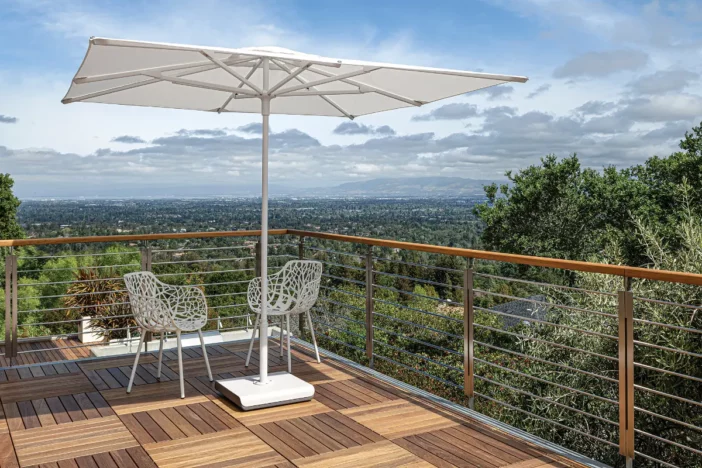
Base & Mount Families at a Glance
Shademaker umbrella bases and mounts fall into three working groups:
- Heavy freestanding bases for larger umbrellas and more demanding environments.
- Lighter freestanding bases for smaller to mid‑size umbrellas in more protected settings.
- Fixed mounts for permanent installations where you want maximum stability and minimal floor clutter.
Which specific base or mount you can use depends on the base weight matrix row for your umbrella, but understanding how each one behaves in the real world will help you make a confident choice.
Heavy Freestanding Bases – Z‑Plate, Infinity & Titan
For larger Shademaker umbrellas where freestanding support is appropriate, these three do the heavy lifting.
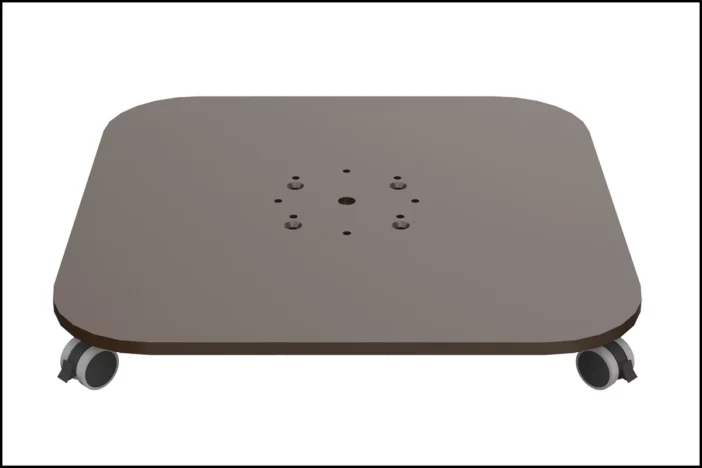
Z‑Plate Patio Umbrella Base
Shape & weight
Stackable square steel plates, roughly 35 inches by 35 inches, in 115‑pound and 225‑pound versions that can be combined to reach higher total ballast.
Design & profile
Low, squared steel plates with rounded corners that soften the look and reduce sharp edges in walkways. Optional locking wheels keep the base where you want it once it’s in position.
Compatible umbrellas
Used with larger umbrellas in the Polaris, Solaris, Atlas and Astral collections.
Best when
- You need serious weight directly under or beside furniture and don’t mind a strong, minimal steel‑plate look.
- Access from curbside to the patio is straightforward and you can bring at least two people plus dollies or similar equipment for the 225 lb plates.
Highlights
- Stackable 115 lb and 225 lb plates make it straightforward to hit matrix‑specified weight targets for demanding umbrellas.
- Rounded corners and low height sit more comfortably in busy seating and circulation areas than squared‑off blocks.
- Optional locking wheels can add controlled mobility on smooth, hard surfaces.
Considerations
- Individual 225 lb plates require proper handling gear and at least two adults, especially on stairs or slopes.
- Without a wheel kit you should treat Z‑Plate as a fixed base once fully assembled.
- The footprint is compact for the weight, but still needs to be accounted for in tight layouts.
Infinity Patio Umbrella Base
Shape & weight
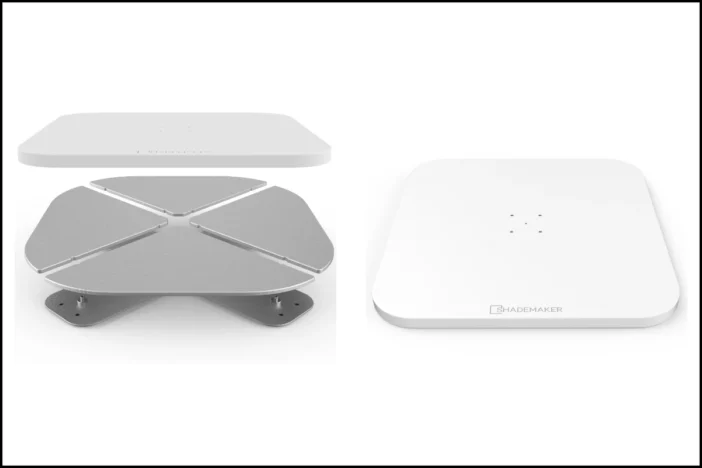
Rectangular galvanized steel frame that accepts multiple steel weight plates under a powder‑coated aluminum lid, configured to reach the total ballast Shademaker calls for in the base weight matrix. Total weight varies by umbrella size and configuration.
Design & profile
Reads as a low, finished platform rather than exposed plates. The aluminum lid hides the ballast and aligns visually with Shademaker’s architectural frames.
Compatible umbrellas
Recommended for larger umbrellas in the Polaris, Solaris, Atlas, Astral, Taurus and Gemini collections.
Best when
- You’re working with larger umbrellas and higher required base weights.
- The path from truck to terrace includes stairs, slopes or long runs and you’d rather move many manageable pieces than a few very heavy ones.
- You want a clean, finished base form that doesn’t advertise how much weight is hiding inside.
Highlights
- Achieves high total ballast using a larger number of smaller plates you can carry one at a time.
- Frame and lid are straightforward to assemble and handle.
- Finished lid keeps the base visually calm and well integrated with Shademaker hardware.
Considerations
- More components to place and secure than a simple cast base, so installation takes more steps.
- Once fully assembled and weighted, Infinity is effectively a fixed base for day‑to‑day use.
- Still needs a reasonable path and staging plan even though the individual plates are manageable.
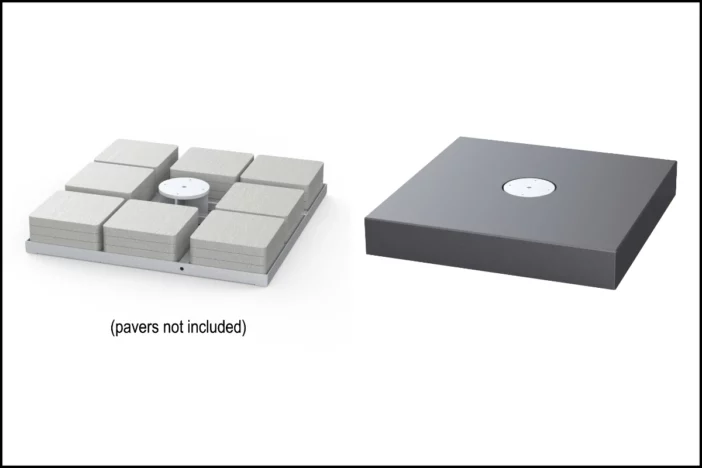
Titan Patio Umbrella Base
Shape & weight
Galvanized steel frame designed to hold up to thirty‑two 12‑inch by 12‑inch by 1.5‑inch pavers beneath a powder‑coated aluminum lid. At full capacity it reaches approximately 850 pounds of ballast.
Design & profile
Broad, low platform with a smooth lid. Once pavers are loaded and the lid is in place, the base presents as a solid, understated block under a substantial umbrella rather than a stack of separate elements.
Compatible umbrellas
Used with the largest umbrellas in the Polaris, Solaris and Atlas collections.
Best when
- You’re supporting larger umbrellas in more exposed sites and want the upper end of Shademaker’s freestanding base capacity.
- You can stage the frame and lid in place, then bring pavers in from nearby with carts or dollies.
- The plan has room for a broad platform and you don’t expect to move the base once it’s loaded.
Highlights
- Offers some of the highest freestanding base capacities in the Shademaker line.
- Ships relatively light; most of the weight comes from locally sourced pavers.
- Lid gives the base a clean, finished appearance despite the amount of ballast it contains.
Considerations
- Requires sourcing, transporting and placing pavers on site.
- Not realistic to move once fully loaded with ballast.
- Needs enough physical and visual footprint in your layout so it doesn’t crowd furniture or circulation.
Lighter Freestanding Bases for Smaller to Mid‑Size Umbrellas
These bases are sized for smaller and mid‑size Shademaker umbrellas in more sheltered environments, where convenience, aesthetics and controlled mobility matter as much as pure ballast.
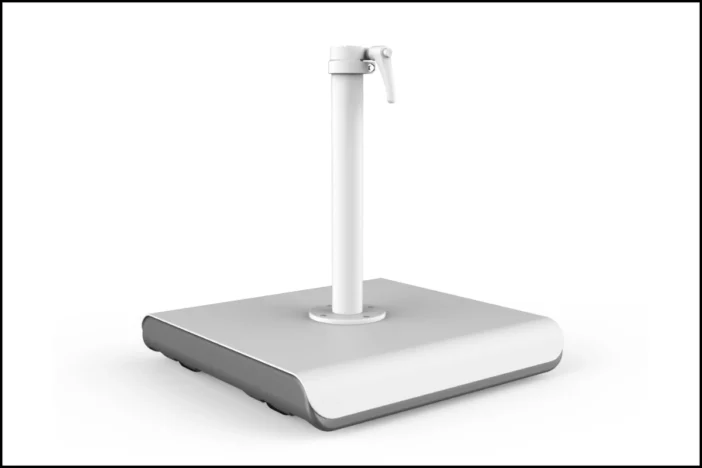
Athens Patio Umbrella Base
Shape & weight
Square cast aluminum base sized for smaller umbrellas, with an integrated stem and an optional 30 lb add‑on weight kit when the base weight matrix calls for more ballast.
Design & profile
Low, crisp square form that reads as a deliberate platform under Aquarius and Libra umbrellas rather than generic hardware. Corners are softened enough to feel comfortable around feet and furniture.
Compatible umbrellas
Matched to smaller umbrellas in the Aquarius and Libra collections.
Best when
- You’re anchoring compact market umbrellas on patios, balconies or covered terraces.
- You want a squared base that visually lines up with furniture geometry.
- The site is relatively protected from strong, gusty winds.
Highlights
- Integrated wheels make short moves on smooth hardscape easy.
- Available in white and dark grey to coordinate with Shademaker frames and common outdoor palettes.
- Optional 30 lb add‑on weight lets you bump ballast within the same base when required.
Considerations
- Wheels are for short moves on flat, hard surfaces, not long routes over rough or sloped terrain.
- Not suitable where the base weight matrix specifies heavier base families for larger umbrellas or more exposed sites.
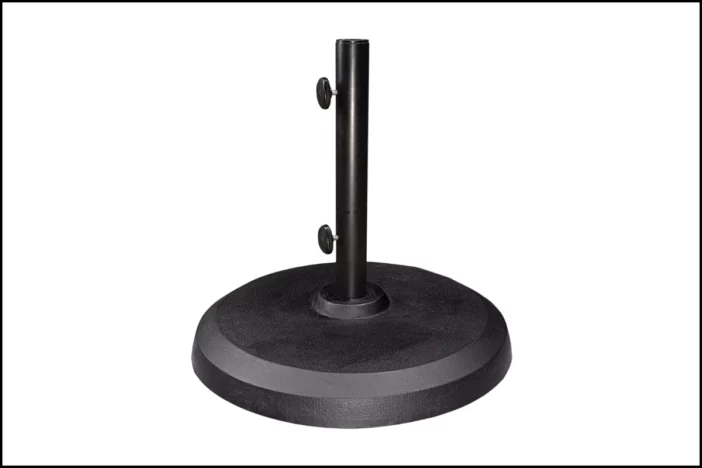
Commercial Cast Aluminum Base
Shape & weight
Single‑piece cast aluminum base sized and weighted for smaller umbrellas as indicated in the base weight matrix. Round or slightly squared footprint depending on the specific model.
Design & profile
Straightforward, compact base with an “equipment” look that still works in high‑end settings. Central stem and clean edges keep the visual noise down.
Compatible umbrellas
Used with smaller umbrellas in Aquarius, Libra and other entry‑size models in the Shademaker line where a simple cast base is appropriate.
Best when
- You need a stable, uncomplicated base for a small umbrella in a sheltered space.
- The base will stay in essentially one location under a table or beside a chair grouping.
Highlights
- Minimal assembly and no separate plates or pavers to manage.
- Solid feel relative to size without heavy‑base logistics.
- Versatile look that fits many outdoor styles.
Considerations
- Not intended for large umbrellas or more exposed settings.
- Single‑piece weight can still be awkward to move up or down stairs without a dolly.
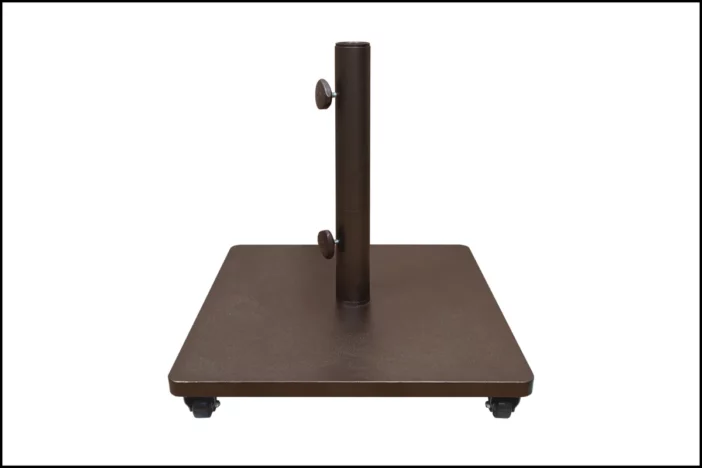
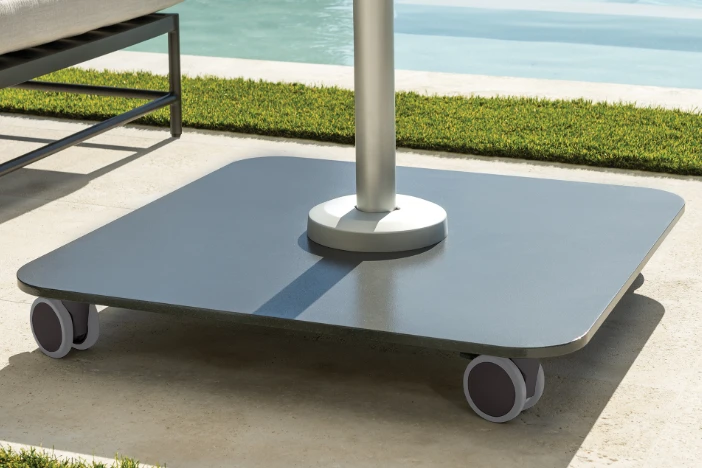
Steel Base with Casters
Shape & weight
Compact steel base with a rectangular or square footprint and integrated casters, sized for smaller umbrellas as specified in the base weight matrix.
Design & profile
Low, minimal base that feels like precise equipment. The modest footprint helps it sit neatly between chairs and tables on a busy terrace without drawing attention.
Compatible umbrellas
Paired with smaller umbrellas in the Libra collection.
Best when
- You’re running café‑style layouts or terraces where small umbrellas move frequently.
- Staff need to roll umbrellas for service, cleaning or reconfiguration without lifting.
Highlights
- Highest day‑to‑day mobility of the Shademaker bases on smooth, hard surfaces.
- Compact footprint fits where larger bases would feel clumsy.
Considerations
- Limited capacity; not appropriate for larger umbrellas or very windy sites.
- Casters work best on flat hardscape, not on gravel, grass or uneven paving.
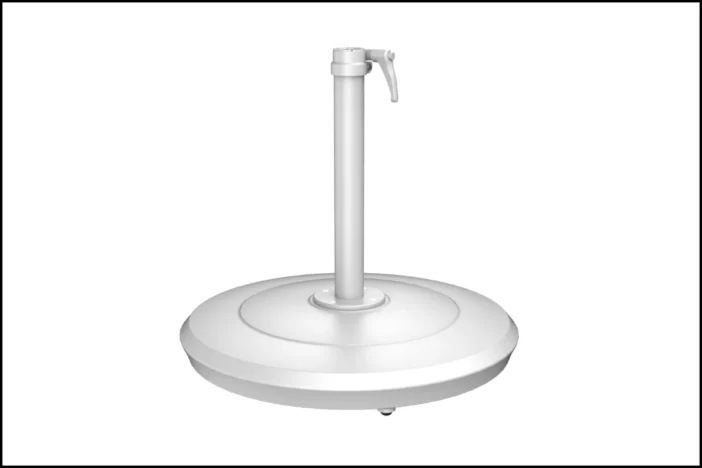
Aurora Patio Umbrella Base
Shape & weight
Cast aluminum base with a low, stepped top and softened corners, sized for smaller to mid‑size umbrellas with an optional 30 lb add‑on weight when needed.
Design & profile
Aurora looks like a low, sculpted base rather than a simple block. The stepped surface and rounded corners give it a softer presence that sits comfortably among lounges and dining sets without shouting “hardware”.
Compatible umbrellas
Paired with smaller and mid‑size umbrellas in the Libra and Aquarius collections.
Best when
- You want the base to visually recede into a furniture layout rather than stand out.
- Umbrellas move occasionally and you want that movement to feel simple for owners or staff.
- You’re working in a protected patio or terrace environment.
Highlights
- Integrated wheels allow short, controlled moves on smooth hardscape.
- Finishes echo Shademaker frame tones, so you can blend or lightly contrast the base.
- Optional 30 lb add‑on weight gives a bit more ballast without changing base families.
Considerations
- Not the right choice for larger umbrellas or exposed, windy sites.
- Wheels are for modest repositioning on good surfaces, not for hauling across long or rough routes.
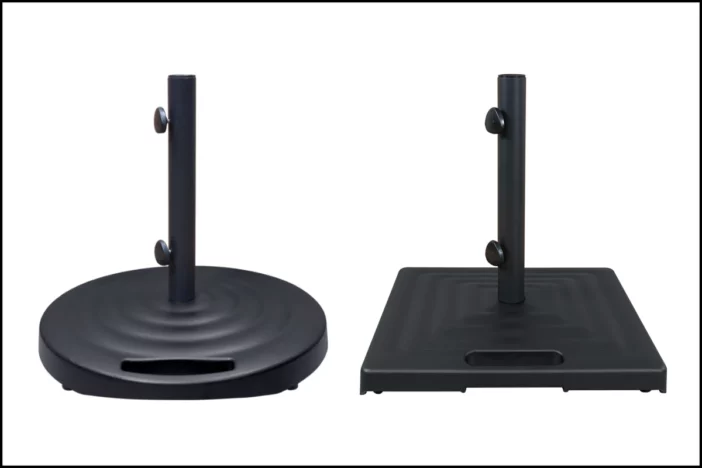
Monaco Cast Aluminum Base
Shape & weight
Cast aluminum base available in both round and square versions for smaller umbrellas, with an optional 30 lb add‑on weight when the base weight matrix calls for extra ballast.
Design & profile
Refined base with a compact footprint and a choice of shapes. The round option softens angular furniture groupings, while the square option lines up with tables and seating that lean more geometric.
Compatible umbrellas
Configured for smaller umbrellas in the Libra collection.
Best when
- You’re anchoring a small umbrella that moves frequently between seating areas.
- Shape and finish of the base are part of the design story.
- You’re working on a terrace or patio with smooth, hard surfaces.
Highlights
- Offered in two shapes (round and square) and finishes such as platinum and black, giving real styling options.
- Integrated wheels and a built‑in handle make it one of the easiest Shademaker umbrella bases to reposition.
- Optional 30 lb add‑on weight lets you scale ballast within the same base design.
Considerations
- Limited to smaller umbrellas; the base weight matrix will point you to heavier options for larger canopies.
- Mobility still depends on surface quality; rough or sloped routes will feel less effortless.
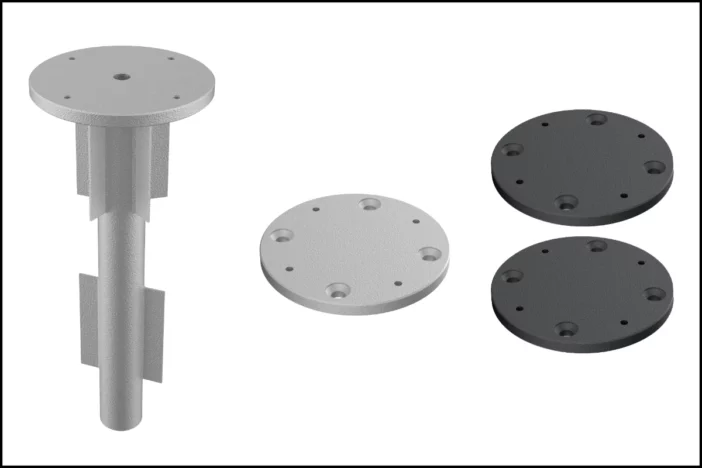
Fixed Mounts – In‑Ground, Surface & Deck
Fixed mounts are Shademaker’s preferred approach when you want maximum stability, minimal floor clutter and a base you never really think about again.
In‑Ground Mounts
In‑ground mounts are sleeves set into a concrete footing below grade that accept the umbrella mast.
Best when
- Umbrella locations are fixed and integrated into the hardscape or landscape design.
- You’re working on hotel pools, resort gardens or long‑term residential projects.
Highlights
- Very high stability with almost no visible hardware.
- No freestanding base to work around during service or housekeeping.
Considerations
- Requires proper excavation and concrete work, typically by a contractor.
- Not a quick “move it later” solution.
Concrete Surface Mounts
Surface mounts bolt directly into a concrete slab or engineered structural surface.
Best when
- You have suitable structural concrete on a terrace, podium deck or pool deck.
- You want clear walkways and consistent layouts for dining or lounge seating.
Highlights
- Stable, low‑profile solution that’s easy to clean around.
- Ideal for restaurants, cafés and rooftop terraces where trip hazards matter.
Considerations
- Requires adequate slab thickness and appropriate anchors.
- Should be coordinated with the GC or structural engineer on elevated and podium projects.
Deck Mounts (Limited Compatibility)
Deck mounts fasten to a framed deck structure and are only approved for certain smaller umbrellas.
Best when
- You’re placing a small umbrella on a well‑built deck and don’t have or want concrete in that zone.
- A fixed position makes sense for the layout.
Highlights
- Allows you to secure an umbrella to a deck without a freestanding base in the traffic path.
Considerations
- Must be attached to proper blocking with correct hardware; not a “screw through the deck board” solution.
- Only compatible with specific models and sizes listed in the base weight matrix.
From Truck to Terrace – Planning Delivery & Set‑Up
With heavier bases and modular systems, it helps to think about how they travel from curb to terrace; a great base choice can feel less great if it has to go up three flights of stairs by hand.
Map the path
- Distance from loading area to each umbrella location.
- Number and type of stairs, slopes, tight turns and gates.
- Surface changes: asphalt to pavers, pavers to gravel, gravel to lawn, lawn to deck.
Match base choice to manpower & equipment
- Z‑Plate’s 225 lb plates usually call for at least two people plus dollies or other material‑handling equipment, particularly on stairs or grades.
- Titan’s frame and lid are easy to move, but thirty‑plus pavers still have to travel from pallet to frame, ideally on carts.
- Infinity’s smaller plates are more forgiving when one or two people are doing the carrying over mixed terrain.
Coordinate installation partners
- In‑ground and surface mounts should be planned with the GC or installer so concrete and anchoring details are built into the project.
- For heavy bases, it’s worth knowing in advance whether final‑mile or white‑glove services are available and cost‑effective for your site, rather than improvising on delivery day.
A little planning here beats the “we need three more people and a better dolly” moment when the truck pulls away.
For hotel and resort projects in particular, articles on umbrella safety standards for beachside hotels & resorts that reference ASTM F3681 underline how important it is to think through anchoring and bases up front when you’re dealing with public spaces and coastal winds.
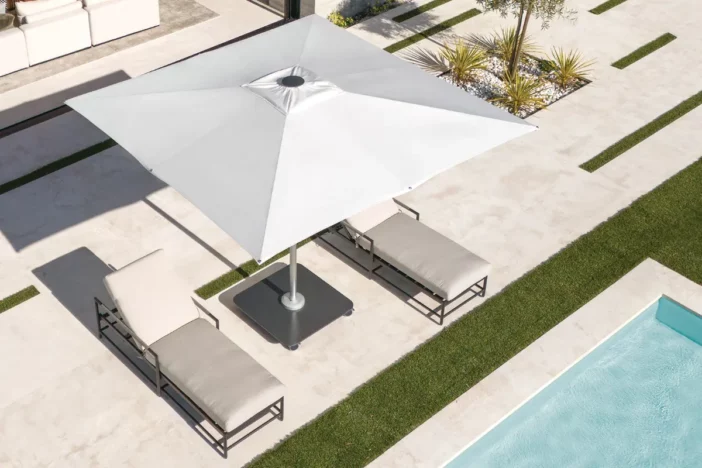
Matching Bases & Mounts to Real‑World Scenarios
Once you know which bases and mounts are approved for your umbrella and site, choose with actual use in mind.
Windy rooftops and coastal decks
- Where the base weight matrix allows it, fully configured Infinity or Titan bases can make sense for larger umbrellas.
- Surface or in‑ground mounts are often ideal on hospitality rooftops and podiums where structure allows and you want clear walkways.
Poolside lounges and resort spaces
- Heavier freestanding bases work well where you can give them adequate footprint away from pool edges.
- Smaller umbrellas on wheels (Athens, Aurora, Monaco or the steel base with casters) make it easy for staff to chase shade along lounges and daybeds.
Restaurants, cafes and hospitality terraces
- Fixed mounts reduce trip hazards and keep table layouts consistent, which simplifies service and nightly resets.
- Where freestanding bases are necessary, compact, low‑profile models in high‑traffic lanes help guests and servers move naturally.
Compact residential patios
- Low‑profile bases like Z‑Plate or the lighter cast bases keep layouts feeling calm instead of crowded with hardware.
- Wheels are most useful when umbrellas truly move between zones, not just once per season.
Project Support from Decor Outdoor
If you’re planning Shademaker umbrellas for a residence, restaurant or hospitality property and want a second set of eyes on base and mount options, the Decor Outdoor team is happy to help. Share your umbrella collection and size, basic site photos and notes on wind exposure and access, and we can help you narrow the approved bases and mounts to a practical short list for your project.
Common Mistakes to Avoid
A few pitfalls show up often in real projects:
- Choosing a base by shape or finish first and only later checking whether it appears with the umbrella in the base weight matrix.
- Under‑weighting umbrellas in windy or exposed locations.
- Underestimating how difficult very heavy components can be to move through real‑world paths, stairs and terrain.
- Ignoring substrate and installation requirements for mounts, particularly on decks and elevated slabs.
Avoiding those will help your Shademaker umbrellas feel as effortless in daily use as they look in the renderings – and keep them behaving more like shade structures than surprise kites.









Leave a Reply