
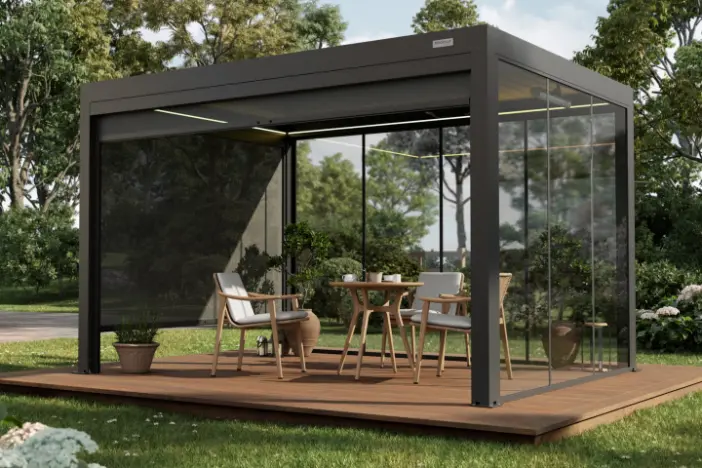
Smart outdoor shade is what happens when your patio covering stops being an accessory and starts behaving like part of the architecture. It turns umbrellas, pergolas and screens into coordinated elements that respond to people, weather and light. That way, terraces and pool decks stay comfortable instead of becoming beautiful but underused spaces.
What are smart outdoor shade systems?
In this context, smart outdoor shade systems are motorized exterior shading elements you control electronically instead of by hand. The essentials stay the same – a motor, a power source and a control layer. They might be a keypad by the kitchen door, a remote at the host stand or an app on a phone. Under this umbrella you’ll typically see three forms – louvered pergola roofs, outdoor roller or zip screens and powered patio umbrellas.
EEach option manages solar gain, glare, wind and rain. That keeps terraces, loggias and rooftop lounges usable through more of the day and year. Indoor automated blinds and shades handle similar issues on the interior side of the glass, but this article focuses on the exterior line of defense.
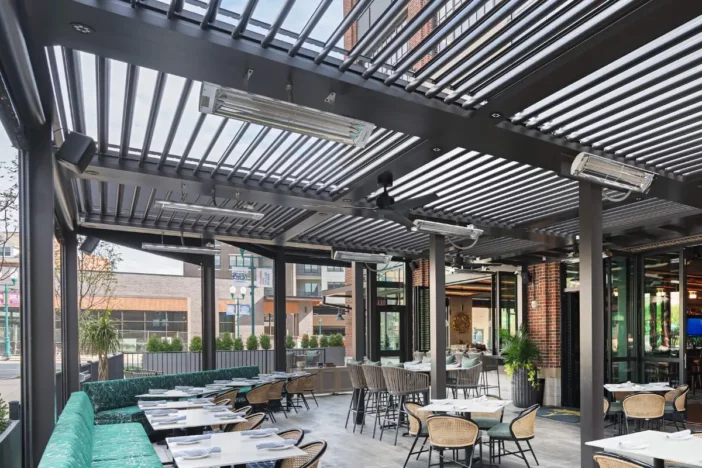
Why is smart shade having a moment?
Outdoor rooms are now central to many luxury projects. Market studies estimate the outdoor‑living structure category in the low‑to‑mid billions of dollars with solid growth, and related automated shading systems are valued in the tens of billions with projected double‑digit annual gains. Properties that once treated patios as leftovers now compete on high‑quality exterior amenity spaces.
The drivers are straightforward – smart‑building adoption, tougher efficiency standards and clients who expect technology to quietly manage comfort. Building‑performance research shows that automated solar shading can dramatically cut cooling energy use. In some climates, it can also reduce heating demand.
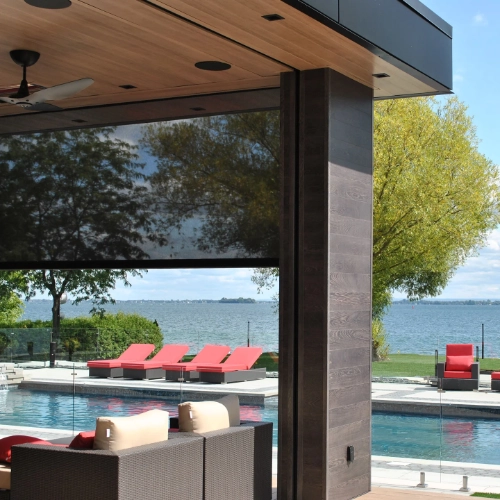
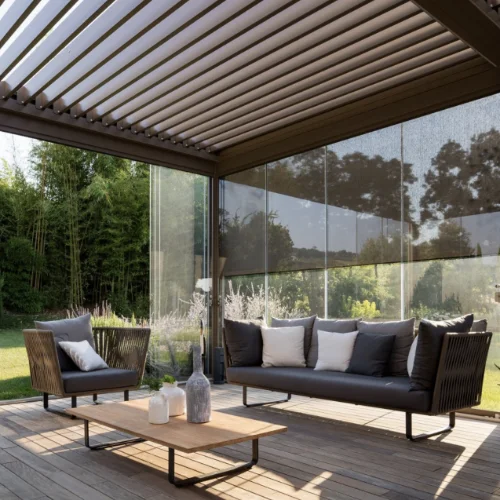
For project teams, that translates into practical benefits
- Comfort – Guests and residents can fine‑tune shade, daylight and breeze instead of fighting glare
- Protection – Finishes, textiles and art last longer when UV is managed at the exterior
- Energy – Well‑designed shading supports glazing strategies and can help ease mechanical loads
- Operations – Repetitive adjustments can be automated so staff and residents aren’t constantly managing fabric and hardware
Technical guidance aimed at architects tends to agree on one point. Automated shading works best when it’s considered early and aligned with daylighting, glazing and control strategies, not bolted on as hardware at the end of the job. Smart exterior shade fits naturally into that mindset.
How do connected outdoor shade systems work?
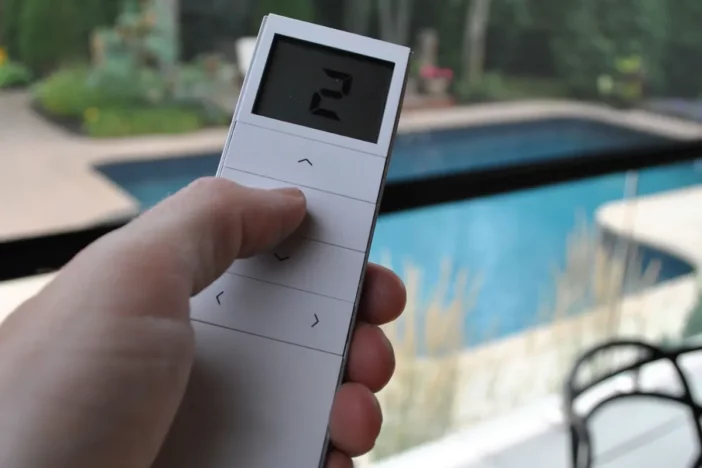
Behind the clean lines, the mechanics are straightforward. Motors move the parts – they tilt louvers, raise and lower screens or open and close umbrellas. Power comes from line‑voltage feeds, low‑voltage wiring, internal batteries or discreet solar panels, depending on the product and the site. Controls range from simple remotes and keypads to touchscreens and mobile apps.
Intelligence comes from how those pieces work together. Modern systems usually include
- Direct commands – Simple open, close and tilt
- Presets – Scene buttons that move groups of shades together, such as “dining,” “cocktail” or “service reset”
- Schedules – Time or sun‑position‑based routines that shift shade as the day changes
- Sensors – Wind, rain and light devices that can temporarily override normal behavior to protect equipment and maintain comfort
The goal is to hide the complexity. For the people using the space, operation should feel like a few clear buttons. Outdoor areas should quietly adapt as light and weather shift.
What are the main smart shade options?
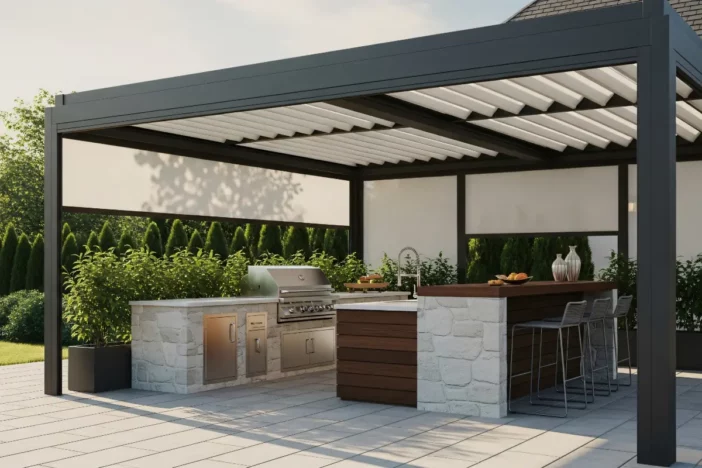
Louvered smart pergolas
Primary role – Create an architectural outdoor room with controllable overhead cover.
Ideal applications – Core dining terraces, lounge areas, poolside hubs and rooftop amenities where a long‑term structure makes sense.
Typical controls – Local keypads and remotes, with optional integration into whole‑home or building systems.
Representative technologies / brands – Motorized aluminum louver roofs with integrated gutters and sensors from specialist manufacturers such as StruXure, Pergolux, Ombra or Terra Summer.
Exterior screens and drop shades
Primary role – Manage low sun, glare, wind and privacy on covered spaces without changing the roofline.
Ideal applications – Covered patios, loggias, pergolas with strong side exposure and façades with large sliding glass or operable walls.
Typical controls – Grouped controls with optional app scenes and sensor‑based automation.
Representative technologies / brands – Motorized exterior screens and drop shades from specialist manufacturers such as Phantom Screens, MagnaTrack or Terra Summer.
Powered, app‑enabled umbrellas
Primary role – Provide flexible, movable shade and evening lighting in areas where a fixed structure would feel heavy.
Ideal applications – Flex zones with movable loungers, small seating groups and restaurant tables that shift with service patterns.
Typical controls – Remotes or simple apps, sometimes with basic scheduling.
Representative technologies / brands – Smart patio umbrellas with motorized open/close, solar charging, wind sensors and app or remote control from brands such as Pasticallo or the Above Height Series smart umbrellas.
Louvered smart pergolas – architectural shade platforms
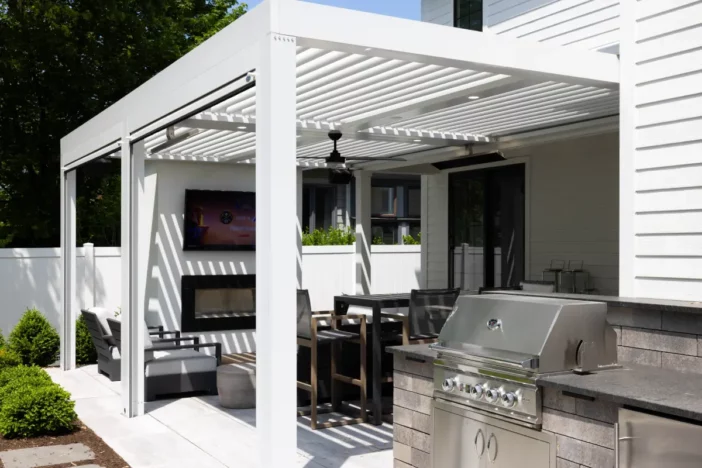
Motorized louvered pergolas have become the anchor element in many luxury outdoor programs. Instead of a fixed slatted roof or stretched fabric, they use extruded aluminum louvers that tilt and sometimes retract. This turns the overhead plane into a controllable ceiling that can admit light, create full shade or shed rain as needed. When the structure picks up existing column spacing and façade lines, it reads as a natural extension of the building.
Specialist manufacturers such as StruXure, Pergomatic and TerraSummer show how far this category has evolved. They pair structural aluminum frames with integrated gutters and drainage, conceal power and control cabling and offer finish options that align with contemporary architecture. StruXure, for example, describes its systems as adaptable outdoor rooms. Louvers, lighting and heaters can be programmed to respond to weather and time of day. Case studies on high‑end residences and boutique hotels show these pergolas defining dining terraces, outdoor lounges and poolside cabanas in a way that feels permanent and intentional.
From a planning perspective, the appeal comes from a blend of control and coherence
- Environmental performance – Louvers admit low winter sun, block high summer angles or close during storms, which supports comfort and glazing choices
- Visual integration – Posts, beams and finishes align with existing structure and material palettes so sightlines stay clean and views stay framed
- Technical flexibility – Hidden cavities accommodate linear lighting, ceiling fans, radiant heaters and audio so equipment doesn’t clutter the scene
- Smart behavior – Sensors protect furnishings and equipment, and scenes coordinate pergola positions with landscape and architectural lighting for different service modes
Because these pergolas behave like small roof structures, they benefit from early coordination among the structural engineer, shade manufacturer and controls team. The best time is during concept or schematic design. At that stage, you can still adjust column spacing, beam depth and control zones without major re‑work. So, the pergola feels like the outdoor room the house or hotel was designed to have rather than a product dropped on a terrace.
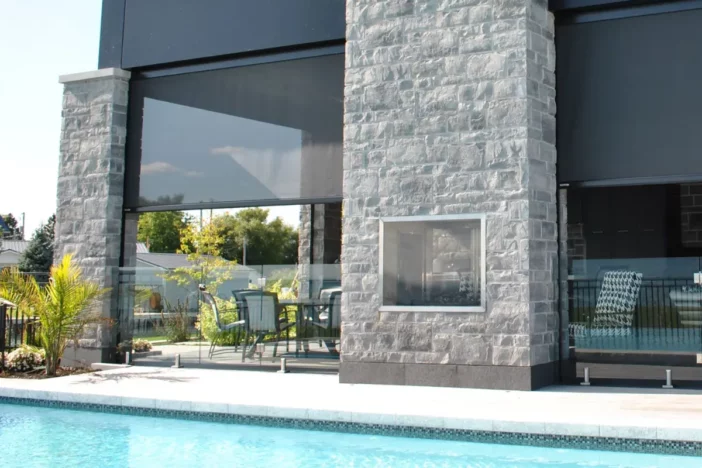
Exterior screens and drop shades
Exterior screens and drop shades are the vertical layer in a smart shade plan for covered spaces with strong side exposure. They descend from compact housings along beams or openings and run down side tracks. The result is a vertical plane that softens light and wind but still preserves views when the fabric is chosen carefully. On terraces with strong western exposure or loggias that catch side wind and rain, they often determine whether the space feels like a room or a corridor.
Paired with automation platforms, these shades can quietly act as an environmental control layer. Integrators often program astronomical schedules. Screens lower on certain façades during peak sun, then rise again when glare is no longer an issue. For residences with large sliding glass walls and for restaurants with operable façades, exterior screens can be a major tool. They significantly reduce glare and heat before it reaches the glass. That reduction is a big help for both comfort and overall energy performance.
Points for design teams to consider
- Fabric – Openness, color and weave affect views, privacy, glare control and heat gain
- Housing – Boxes can be recessed into beams or fascia elements so the hardware disappears
- Controls – Aligning screen presets with interior shade and lighting scenes keeps operation intuitive for guests, staff and homeowners
On design‑driven properties, these systems are about managing the feel of a space at specific moments – sunset drinks, mid‑afternoon service or shoulder‑season brunch – rather than about adding a gadget.
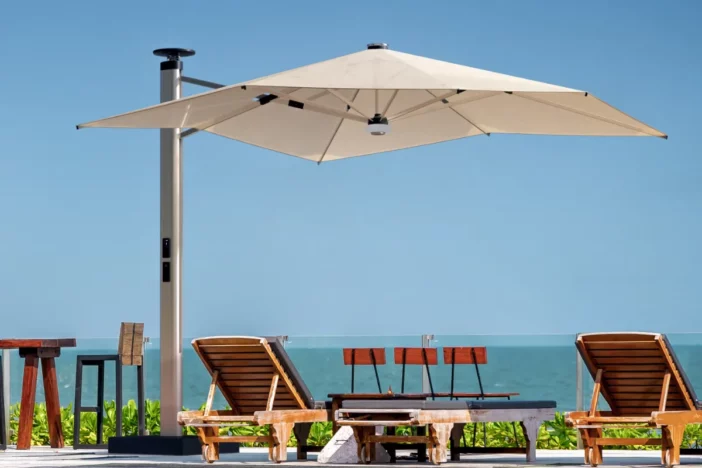
Powered and app‑enabled umbrellas
Powered, app‑enabled umbrellas are the flexible layer in a smart shade plan, adding movable shade and integrated lighting where a fixed structure would be too much. They use familiar market and cantilever forms but add powered lift and tilt. They also integrate lighting controlled via remotes or mobile apps. Some models hide small solar panels on the canopy to charge internal batteries, which helps in areas where routing power to the base would be intrusive.
These umbrellas shine in zones where a permanent structure would feel heavy or conflict with sightlines. They can move or rotate with chaise lounges, small seating groups or occasional dining tables. This gives planners the freedom to reconfigure without calling a contractor. The better lines focus on smooth motor operation and robust masts and bases. Their lighting also feels like part of the overall scheme rather than a novelty.
Because wind ratings and proper weighting matter—especially on rooftops and exposed pool decks—a useful rule of thumb is to watch how umbrellas behave in that area. If neighbors routinely store umbrellas on their sides to keep them from moving, that zone probably needs a structural or screen solution first. Powered umbrellas can then act as a secondary layer. Once those basics are in place, connected umbrellas offer a light‑touch way to add smart control. They also add nighttime ambiance in areas that don’t justify a full pergola or fixed canopy.
Luxury smart umbrella examples
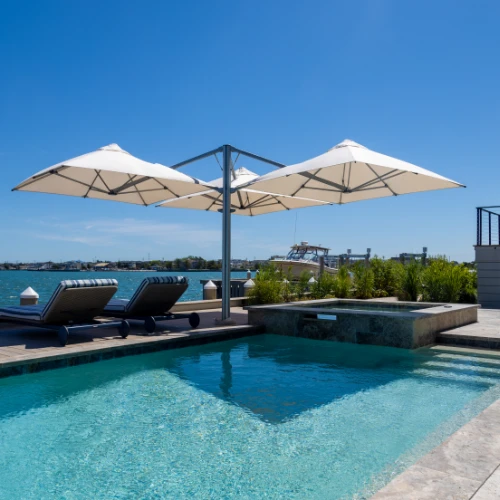
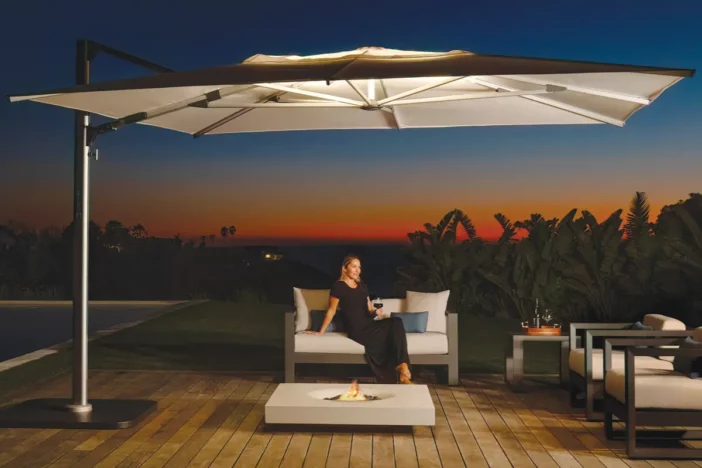
Multi‑canopy cantilever umbrella with integrated hub lighting, upgradeable with a smart battery and app so you can dim, schedule and group lighting scenes across multiple umbrellas from one place.
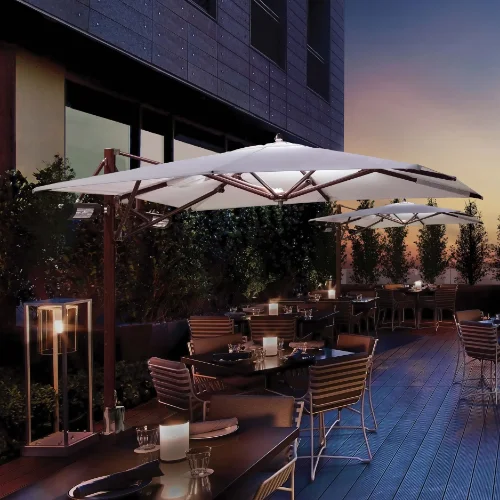
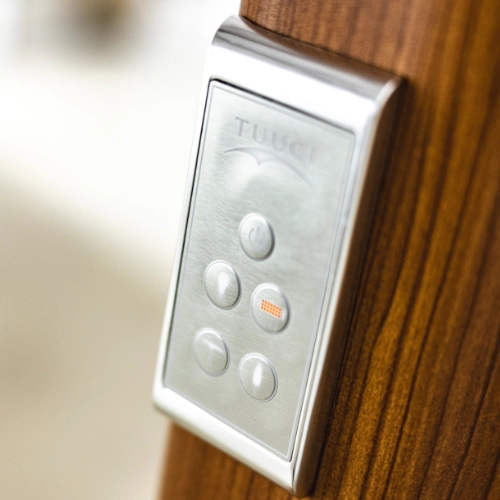
An architectural side‑post parasol with an automatic telescoping mast, optional Ambia LED up‑lighting and infrared heaters, all managed from an integrated control panel when you add Tuuci’s automation package.
Where indoor automated shading fits
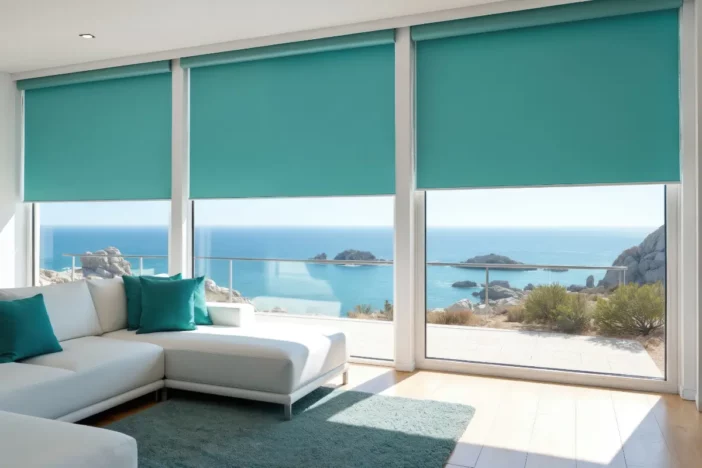
Interior automated shades and blinds share the same logic as these exterior systems and are worth acknowledging, especially on projects that already include lighting and control integration. Their jobs are straightforward – manage glare, protect interiors and help reduce cooling loads by controlling sunlight at the glass.
Technical guidance for architects often notes that the best results come when exterior and interior shading are considered together. Simulation tools can help teams understand how they interact with glazing, orientation and climate. In practice, that might mean exterior louvers and screens handle most of the solar control. Interior shades, on the other hand, fine‑tune daylight and privacy. For clients used to unified control of lights and HVAC, placing shade presets on the same touch panels and keypads keeps daily operation simple.
Mentioning interior systems keeps the conversation focused on the whole daylight and comfort story. It also aligns with building‑science guidance on sun control and shading devices. That framing usually resonates with architects, designers and detail‑oriented homeowners.
How should you zone smart shade in your outdoor space?
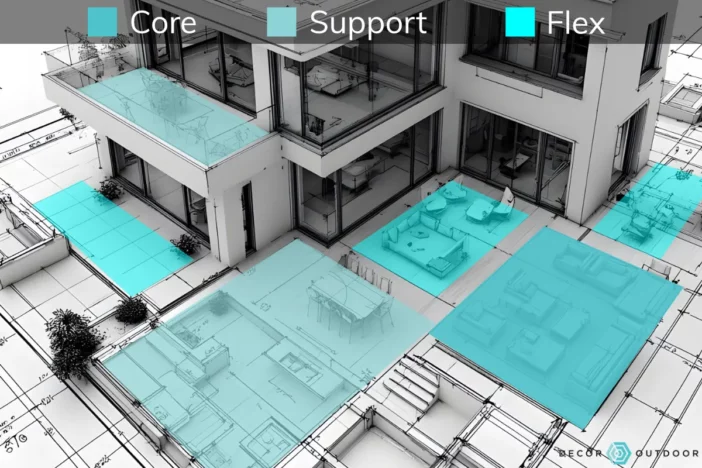
A useful way to zone smart shade on luxury projects is to think in terms of three areas – Core, Support and Flex. This simple framework keeps decisions aligned with how the space will actually be used rather than with any single product. We suggest this Core–Support–Flex approach to review plans with clients and design teams. It keeps everyone focused on program and experience.
For a broader planning framework that also includes umbrellas, pergolas and other non-motorized solutions, see our guide to planning shade for real outdoor spaces.
Core Zone – The anchor area
This is the main dining terrace, lounge or poolside hub. It usually deserves a louvered pergola or other architectural structure that defines the room and provides reliable shade and rain protection. As a rule of thumb, the controllable overhead structure should cover at least the furniture footprint. Ideally, it extends about 3–4 feet on all sides for circulation and splash zones.
Support Zones – Adjacent spaces that extend the experience
Support zones include smaller seating pockets just off the main terrace, outdoor bars, grill stations or transitions to the pool. These areas often benefit most from exterior screens, smaller pergolas or canopies that carry the architectural language without duplicating the main structure. Large rotating or multi-canopy cantilever umbrellas with integrated LEDs are also an option to shade and illuminate outdoor kitchen or dining areas. Strategically placed shade sails are a low tech option as well.
Flex Zones – Spaces that change often
Flex zones are spaces that move with the season – loungers that slide around, daybeds that rotate or areas used for occasional events. Powered market umbrellas with mobile bases are usually the most efficient way to serve these spaces because they can reposition as furniture plans evolve.
For project teams, this framework also maps neatly onto design phases:
- Concept design – Map Core, Support and Flex zones; sketch spans and heights.
- Design development – Lock structure, drainage and power for Core/Support.
- Construction & build – Finalize fabrics, control groupings and umbrella placements.
Care, longevity and expectations
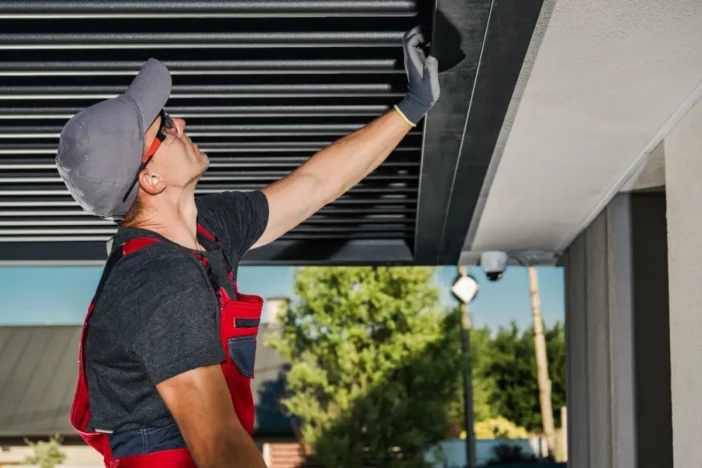
Connected shade systems sit closer to building components than furniture, and they perform best when treated that way. Routine care usually means cleaning louvers and tracks and washing fabrics with appropriate solutions. It also includes checking fixings periodically and confirming that control presets still match how the space is being used. On more complex projects, many manufacturers and integration partners offer seasonal service to keep everything operationally sound.
Respecting design wind ratings and using safety modes is equally important, particularly for umbrellas and exposed screens. In hospitality settings, clear operating procedures and basic staff training go a long way. For private clients, a brief orientation with their integrator or landscape architect at handover can prevent most future frustrations.
Handled this way, smart shade becomes part of the property’s quiet infrastructure. It also helps justify investment in high‑end finishes and furnishings by keeping spaces comfortable and active far more often.
Where to go next
If you’re planning a specific project, it helps to lock in the fundamentals first. Then you can layer controls and automation where they have the most impact.
- Patio umbrella buying guide – A foundation for canopy geometry, proportions, fabrics and bases before you choose a powered or app‑enabled model, whether you’re outfitting a private terrace or a restaurant patio
- Shade structure buying guide – Covers frameworks, attachment methods, materials and planning basics, which makes specifying a louvered pergola or screened structure that suits the architecture much easier
Once those baseline decisions are made, you can decide where smart control, sensing and integration will deliver the most value. It’s important to consider the needs of the client, the operations team and the design itself. It should not simply be about adding another connected object to the property.
References – market, technical and design sources
- IMARC Group – “Outdoor Living Structure Market Size, Trends, Report 2033” – Global outdoor‑living structure market estimates and projected growth.
- Grand View Research – “Outdoor Living Structures Market Size | Industry Report 2030” – Analysis of pergolas, cabanas and related structures in residential and commercial projects.
- Deck Specialist – “Outdoor Living Structure Market Set to Double by 2034” – Discussion of demand for permanent outdoor structures and amenity spaces.
- GMI Insights – “Automated Shading Systems Market Size & Share Report – 2032” – Valuation of automated shading systems, forecast growth and key drivers.
- Research Nester – “Automated Shading Systems Market” – Summary of energy‑savings potential from automated solar shading and its role in high‑performance buildings.
- HTA / Arcenal – “9 Essential Elements To Consider For Shading” – Practical advice for integrating shading and controls in design and AV projects.
- “Impacts of Automated Shading in Building Projects” – Technical white paper outlining design‑stage coordination recommendations for architects and engineers.
- Enviroscreen – “A Guide for Architects Using Solar Shading Devices” – Design considerations for exterior shading devices and integration with façades.
- StruXure – “Smart Pergolas Boost Energy Efficiency & Outdoor Comfort” and case studies – Examples of smart louvered pergola capabilities and design philosophy.
- Pergomatic, TerraSummer and similar manufacturers – Product and case‑study material illustrating structural aluminum pergolas with integrated drainage and controls.
- Smart umbrella and exterior‑shade brands – Articles and product pages showing trends in powered umbrellas and connected outdoor shade.









Leave a Reply